Gundruk is a fermented, sun-dried leafy green made from mustard or radish leaves, eaten across Sikkim, Darjeeling and Kalimpong.
Gundruk hits home every time there is even a mention of its name. When we particularly talk on the subject of traditional local cuisines of the north eastern India specifically Sikkim, Darjeeling and Kalimpong regions, it is not at all a matter of surprise when we mention the soup made from gundruk locally called (gundruk ko jhol. The recipe for this famous soup has been previously mentioned in an article on this site. Gundruk is an umbrella term for fermented leafy greens that may be made from Rai ko saag (mustard leaves) or Mula ko saag (radish leaves). It is a quintessential ingredient in almost all the Nepali or Gorkhali households no matter where they may be living. The taste of Gundruk truly transports us back to our homes and wooden kitchen and a warm wood-fired stove in our native lands.
Gundruk is not just consumed as a soup or a jhol, but also in form of pickle and a salad as a side dish. Today we will be learning about how to recreate the perfect traditional gundruk pickle at home.
The Gundruk pickle is a super up lifter to meals and is especially exceptional with the humble Daal Baht combo. It may be a thing of intrigue for people who cannot connect to this food in the cultural way, but intrigue is good because you are about to fall absolutely head over heels for this recipe.
How gundruk is originally made?
We all know by now that the entire north east is blessed not only in its extremely favourable climate but also with the rich Himalayan soil under our feet. In the particular regions of Kalimpong, Darjeeling and Sikkim farmers are known to grow vegetables such as spinach, radishes, mustard, mustard leaves etc. in really large areas, so as to supply efficiently the huge demand there is for these kinds of greens.
Most of the harvest is sold fresh in local markets. Greens that are left over, such as radish leaves and mustard leaves that are past their best, are kept for making gundruk. The traditional process uses no added preservatives.
gundruk left in the sun to dry
The greens that make up gundruk are mustard leaves, radish leaves, spinach leaves, saag leaves and sometimes even cabbage leaves. Once radishes, cabbages, saag and spinach are harvested from the garden, they are washed in warm water thoroughly. This washing vigorously ensures any kind of soil particles or dust to wash right off of the leaves. The leaves are then roughly crushed with a stone and after this the leaves are stored in an air tight container or a black plastic bag and stored in a dark corner of the household for a good 1-2 weeks.
leaf beating to release flavour before fermentation
This storing of the leaves allows the fermentation to happen at a consistent rate . Then after the fermentation, the leaves are taken out of the storage and spread out on a Nanglo which is a circular tray made by woven bamboo (an essential tool in a Nepali household). The leaves are then left out in the warm winter sun for it to lose all the moisture.
crisp fermented gundruk
The gundruk must be hard and crisp almost and not soft and soggy. So the leaves are kept under the sun for many days until the leaves turn dark brown in color, almost black, frilly, hard and crisp. When the leaves acquire all these traits, the gundruk is ready.
The characters of a gundruk:
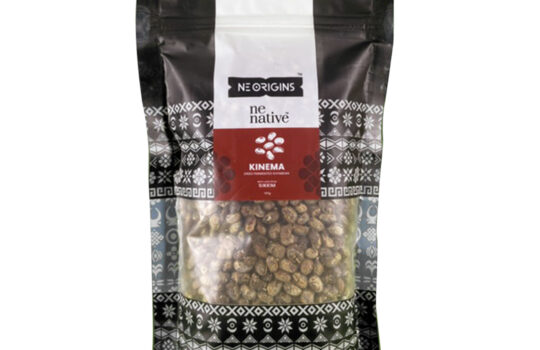
This fermented goodness has a earthy, mushroomy flavours at the same time is sour and perfectly tangy. The texture of the leaves after boiling becomes thick, leafy, fibrous and chewy. Even though the vegetable goes through the process of fermentation, it is not so pungent in its aroma which can get a bit overbearingly strong for people who have never tried fermented foods such as the Axone or Kinema (also called the natto in Japan). The gundruk in it making process and flavors will be similar to the famous Korean Kimchi to be exact.
Without further ado let us head to making of the Gundruk ko achar.
Gundruk ko achar
Ingredients:
- Two large fistfuls of Gundruk leaves
- 50 gms soybean
- Half a fistful of roasted peanuts
- 2 large tablespoons of mustard oil
- Salt as per taste
- One large tablespoon of lemon juice
- One whole garlic, peeled and crushed
- One whole tomato diced into minute cubes
- Half a red onion diced minutely
- 2 Dalle chillies cut into small squares.
Procedure:
- In a big bowl add water (it should not be hot or the flavours will leave the gundruk) . add the gundruk leaves in this bowl and let them soak for an hour and a half for the gundruk to rehydrate.
- The soybean should now be roasted in a pan with or without using oil.
- In a grinder grind the dalle chillies along with the garlic, tomato and salt.
- Roughly chop the roasted peanuts into smaller bits.
- Now in a clean bowl, add the soaked gundruk, the ground spices, the peanuts, the oil, lemon juice, roasted soybeans and red onion diced and mix thoroughly.
- If the mix feels too dry to your liking, just add a little water and give it a good mix.
- Your gundruk ko achar is perfect and ready to be consumed. Best eat it with plain steamed rice and lentils or daal.
Related: Northeast Indian pickles: which jar to try first and how to store pickles so they keep.